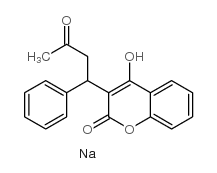
Warfarin sodium(including isopropanol)
Appearance: White to off white crystalline powder
Organic Impurities:4-Hydroxycoumarin≤0.3%;Benzalacetone≤0.3%;Alice’s ketone≤0.3%;Any individual unspecified impurity≤0.10%;Total impurities≤1.0%
Isopropyl Alcohol Content (crystalline clathrate form):8.0%–8.5%
pH:7.2–8.3
Water:NMT 0.3% for the crystalline clathrate form
ASSAY(USP):97.0%–102.0% on the anhydrous basis for the amorphous form or on the anhydrous and isopropyl alcohol-free basis for the crystalline form.
Mechanism of action
Warfarin is a derivative of coumarin, with a chemical structure of 3- (a-phenylacetone) -4-hydroxycoumarin. There is no anticoagulant effect inside the test tube, that is, it does not participate in in in vitro anticoagulation. It mainly inhibits the synthesis of vitamin K-dependent coagulation factors II, VII, IX, and X in liver microparticles, but the effect occurs slowly, with the maximum effect occurring within 3-5 days. Vitamin K can promote the carboxylation of amino terminal glutamic acid of vitamin K-dependent coagulation factors II, VII, IX, and X into gamma carboxyglutamic acid. Carboxylation can promote the binding of vitamin K-dependent coagulation factors to phospholipid surfaces, thus accelerating blood clotting. Gamma carboxylation requires the participation of reduced vitamin K (vitamin KH2). Dicoumarin inhibits the activity of vitamin K epoxide reductase, thereby blocking the production of vitamin KH2 and inhibiting the gamma carboxylation of vitamin K-dependent coagulation factors. In addition, vitamin K antagonists can inhibit the carboxylation of anticoagulant proteins C and S.
Description
English Name:warfarin sodium
Chemical Name:Sodium 2-oxo-3-[(1RS)-3-oxo-1-phenylbutyl]-2H-1-benzopyran-4-olate
Molecular weight:331.32
CAS NO.:129-06-6
LogP:4.04780


Reviews
There are no reviews yet.